While living and working in Edinburgh in 2008 I set out to write one million words in 366 days... but only managed 800,737.
Showing posts with label essays. Show all posts

Thursday, March 13, 2008

Uncovering the Secret to... Covers

Today I would like to talk about cover versions. Specifically covers recorded and released by artists, as opposed to covers performed live, which are slightly different beasts.

I’m not going to make a numbered list of my favourite covers because a) I change my mind every ten minutes and b) it’s been done a million times elsewhere. But for those wanting a list, this one of the100 best (courtesy of RetroCrush) is pretty good. I agree with Devo’s ‘Satisfaction’, CCR’s ‘Heard it Through The Grapevine’ and a Johnny Cash cover making the top ten, but Joe Cocker’s ‘With A Little Help From My Friends’ (8th) would be even higher on my list. There’s also a list of the 100 worst covers. All entertaining reading, but what is it with covers? Why do some work and some tank?

Here’s my thoughts.

There are two types of bad covers:

1. What’s The Point? covers (versions too close to the original); and

2. Just Plain Wrong covers (versions that sound like crap).

Both of these are subjective classifications, though the level of overlap (agreement) with the first is likely to be larger than with the second.

The rules for what (I think) makes a good cover are the inverse of what a bad cover is. A good cover has something new about it to justify its existence and works as a stand alone song (i.e. it sounds good).

The reason a good cover can sometimes be better than a good new song is the way it works on two levels – speaking back to the original while rocking your socks off in the present – while a new song is like a first line of dialogue. I think that’s why I’m so drawn to covers.

But even bad covers have their place, like tourists in your hometown: even if its just for those moments when you’re walking home and someone is taking a photo of a building you walk past everyday and this rekindles a little wonder in your environs.

A cover of any sort, good, bad, or forgettable, should at least make you think about the original. A What’s The Point? cover may sound the same as the original, but something will be lacking. What’s that something? Well, it’s whatever made that band special. Britney Spears’ cover of ‘I Love Rock and Roll’ sounds quite similar to Joan Jett’s, but everyone knew Britney didn’t love Rock and Roll, whereas Ms. Jett pulled off her leathers with aplomb (minds out of the gutter, please) - - but of course the original was by The Arrows, which sounds a bit flat, revealing a) The Arrows weren’t cut out for rock and b) they still managed to write a great rock song.

A Just Plain Wrong Cover will remind you of the aural pleasure contained in the original. Compare and contrast Madonna and Don McLean’s versions of ‘American Pie’.

A good cover will always bring something out of the original version the next time you hear it. A great cover will show you things in a song you never knew were there.

But covers don’t just happen. An artist (or producer, or someone in the A&R chain) must select a song to cover from the millions available. The aim can vary: to make a hit; as a b-side to reward fans and attract trainspotters for particular artists; to mix things up on an album; to make link the cover artist and the original (or highlight the differences)… but there is always an aim. There are no accidental covers.

Which leads me to define the following cover categories:

1. Artist Covers a Well-Known Song by a Similar Artist
(similar could be in terms of style, genre, fame, or era)
Examples:
Paul Weller covering Neil Young’s ‘Birds’ (Craig’s verdict: Great cover; sadly missing from the internet)
Flying Burrito Brothers covering The Rolling Stones’ ‘Wild Horses’ (Craig’s verdict: Passable cover)
Fastball covering Elvis Costello’s ‘Out of My Head’ (Craig’s verdict: Terrible cover –sounds just like Elvis Costello)

This first category is actually quite rare. I struggled to think of a terrible cover, a) because it’s hard to completely screw up a song similar to what you’re used to, and b) there aren’t that many. Most covers belong to this next category:

2. Artist Covers a Well-Known Song by a Dissimilar Artist
(again, difference could be in terms of style, genre, era, gender)
Examples:
Sugababes covering the Artic Monkey’s ‘I Bet You Look Good on the Dancefloor’ (Craig’s verdict: Great cover)
Chris Cornell covering Michael Jackson’s ‘Billie Jean’ (Craig’s verdict: Passable cover)
Scissor Sisters covering Pink Floyd’s ‘Comfortably Numb’ (Craig’s verdict: Terrible cover… why does it make so many Top Cover lists? Why?)

The reason most covers come from here is it’s easier to make the song your own if the original is nothing like your normal sort of music. But there’s also more potential for this to blow up in your face.

You could break this category in two if you wanted: pop artists covering songs with integrity and artists with integrity doing pop songs… but let’s just leave it there for now.

Sometimes a song will fall somewhere between categories 1 and 2, like The Futureheads’ cover of Kate Bush’s ‘Hounds of Love’ (Craig’s verdict: Great cover), which is a completely fresh angular rock take on an off-beat pop song, BUT you can still see some parallels between the Futureheads and Kate Bush as artists. This might actually fall into the next category for some people…

3. Artist Covers a Little-Known or Forgotten Song
This could be a forgotten album track by a well-known artists, or a song from a band that never quite broke into the mainstream or didn’t age well.
Examples:
Gary Jules covering Tears For Fears’ ‘Mad World’ (Craig’s verdict: it was great cover until I got sick of it)
Wet Wet Wet covering the Troggs’ ‘Love Is All Around’ (Craig’s verdict: it was a passable cover until we all got sick of it)
Pearl Jam covering J. Frank Wilson’s ‘Last Kiss’ (Craig’s verdict: I have no idea how this song can be Pearl Jam’s biggest selling single… I could never stomach it).

This can be a trixy category to pull off, but when it works, the songs usually go stratospheric. These are the songs where you find out one day ten years later that they were covers. See also: Whitney Houston’s ‘I Will Always Love You’; Aretha Franklin’s ‘RESPECT’ and The Black Crowes’ ‘Hard To Handle (both originally by Otis Redding); Kylie’s ‘Locomotion’…

Sometimes the motivation of artists performing Type 3 covers can be genuine: trying to introduce listeners to bands they personally admire and their listeners might not have come across (e.g. Monster Magnet’s covers). But not often.

Flight of fancy: I think it would be cool to have a band which had a narrowly defined cover criteria, such as songs from albums which artists which have disowned (implicitly or explicitly). Might I suggest, ‘Anyone Can Play Guitar’ from Pablo Honey, ‘Burnt’ from News and Tributes, and ‘One Night in Copenhagen’ from In Between Evolution.

Back to earth:

What all this categorisation illustrates, to me at least, is that intention is the most important factor when weighing up the value of a particular cover. I like the Sugababe’s pop-ing the heck out of the Arctic Monkey’s indie smash. I can’t stand Jessica Simpson pop-ing out all over what was essentially a novelty song for Nancy Sinatra.

Sometimes a cover can leave all the boxes unticked and still deliver. Warren Zevon’s cover of Bob Dylan’s covered-to-death ‘Knocking on Heaven’s Door’ sounds superficially similar to other versions, but because he was literally knocking on heaven’s door when he selected this song and recorded it (for his final album, The Wind), it’s incredibly powerful. It is also a great compliment to Dylan that he could write the song to sum up this moment in another wonderful songwriter’s life when he was decades from death’s door (and writing for a movie soundtrack to boot) – this is that “speaking back to the original” thing I was talking about earlier.

Now compare Zevon’s version (sorry, this is the closest I can find) to Avril Lavigne’s. If you were to transcribe the music, or look at the graphs of the soundwaves, these songs would be very similar, but one is meaningless rubbish the other is Art. No prizes for guess which is which.

So, while I may not have given a numbered list today, I think I’ll end on some more recommended cover artists.

Johnny Cash – lots of people list ‘Hurt’ as a top cover (in the same vein as Zevon’s ‘Knocking’), but I think ‘Rusty Cage’ is cooler, and there are about fifteen other songs from his final years which meet my “good” cover criteria.

William Shatner – Some people can’t stand the fact he “ruined” (their words, not mine) ‘Common People’, but these people don’t have a sense of humour, which is something music in general needs more of.

The Foo Fighters – ‘Baker Street’, ‘Band on the Run’, ‘Down in the Park’… excellent song selection and enough new flavourings to satisfy this palate.

And my pick from left field:

Grand Funk Railroad - Would make it on the basis of their version of the Stones’ ‘Gimme Shelter’ alone, but a surprising number of their other hits were covers too.

Okay campers, that’s all from me. Thanks for reading this mammoth post. I’ve enjoyed bringing it all together.

Monday, February 18, 2008

Even Better Than The Real Thing

I like writing. Most of the time it is not a chore to spend four hours after work typing words with a serious expression on my face. But sometimes I prefer to write something from the very top of my brain and not care about whether it’s Good or Not Good, or Publishable or Unpublishable.

Off and on these past few weeks I have been diverting these top-of-the-brain impulses into one particular Word file, which kind of became a love letter to Wikipedia. I’m weighing up whether to post this love letter to Wikipedia (a.k.a. ‘Orbital Resonance’) online, but I’d say there’s an 80% chance it will appear somewhere in the next fortnight.

Until then, here is something about Wikipedia, but also not about Wikipedia. I was looking for something a bit different to name a character and found my way onto the Wikipedia page for The Sons of Noah (the biblical figure) and then onto the following two pages:

Nuwaubianism

Dr.Malachi Z. York

According to Wikipedia:

Nuwaubianism is an esoteric cosmology, a collection of religious teachings, a group of religious, tribal, and fraternal organizations, and a set of cultural practices that is multifaceted and ever-changing.
Now, until two hours ago, I don’t think I had any prior knowledge of the movement or its founder, and what follows is discussion based solely on two Wikipedia pages. It’s mind-blending to read too much of this stuff, so to come out at this stage and say anything too negative (or positive) about Nuwaubianism or the people involved or even the dude who created the faith (and is currently serving 135 years in prison for child molestation) would be rash and perhaps even dangerous.

What I want to say is, when I read through some of the stuff on the Nuwaubian page, I thought: there is a great brain for fiction being used for something else. What’s the difference between someone (Malachi Z. York) writing: “People were once perfectly symmetrical and ambidextrous, but then a meteorite struck Earth and tilted its axis causing handedness and shifting the heart off-center in the chest,” and, say, Kurt Vonnegut’s Slapstick, where Chinese people shrink themselves to the size of postage stamps so they can all fit in their country?

The difference, of course, is that one is fiction (Vonnegut) and the other purports not to be (York).

To skim through the bullet points under the Other Nuwaubian Beliefs heading is like reading the unused plot ideas from one of Vonnegut’s notebooks (or Philip K. Dick’s or William Gibson’s or George Saunders’).

  • …some aborted fetuses survive their abortion to live in the sewers, where they are being gathered and organized to take over the world.
  • There is an underground road connecting New York and London.
  • The clocks on Earth used to have a “tick” and a “tock.” Now there is only the “tick.” So time has been changed, and that missing “tock” is up for grabs that can be utilized by extraterrestrial beings who overstand this “altered time,” and they can come in and out of this dimension at will.

In isolation, these might be harmless ideas, or they might be the seeds of satirical sci-fi-leaning stories which entertain readers and supply the odd ‘uh-huh’ moment. But when you start to paste all these ideas together into one cohesive [sic] theology [sic], and tell people to not just suspend their disbelief (as with fiction), but actively believe, that my friends is when the trouble starts.

Actually, I take back that claim that Other Nuwaubian Beliefs section could be mistaken for ideas from the abovementioned writers because only a small fraction of the bullet points are as neutral as those I selected. Most valorise ‘Nubians’ and demonise the many forms of ‘Other’ in a not very ulterior motive. Some of the lighter examples include:

  • Alcoholic beverages are made cheaply available to Nubians by the powers that be in order to preserve their blood and organs better “(just like they preserve organs in jars in laboratories)” for later extraction.
  • Disco was created by the devil to win the souls of the Nubians.

This could still be the brain of a great satirist brain at work. Except, this brain isn’t being used for satire but scripture. And then there’s the concept of Sound Right Reasoning, where:

Nuwaubians try to discover the deeper meanings of words by using a method in which words are decomposed into syllables and then phrases are created using similarly-sounding syllables, so that for instance caucasian becomes “carcass-asian,”[citation needed] extraterrestrials becomes “extra-terra-astrals,”[63]gospel becomes “ghost spell,”[64] Jesus becomes “Jah+Zeus,”[65] planet becomes “plan E.T.,”[66] and television becomes “tell lie vision.”[35]
Ludicrous, right? It sounds like something the title character from George Saunders’ novella The Brief and Frightening Reign of Phil would say.

I’m avoiding a clause-by-clause takedown of Nuwaubian literature because the people I imagine I’m talking to right now don’t need to have What’s Wrong With This Page spelt out to them. And because that’s not what is the most interest to me.

What I’m most interested in is my reaction that some of this would make good fiction. That there is something so appealing about a man who has sixty aliases listed at the bottom of his Wikipedia page and distorts a 1001 source mythologies into this new thing crawling with Vonneguttian ideas, that I am able to scroll over sentences such as, “state prosecutors literally had to cut back the number of counts [of molestation] listed — from well beyond a thousand to slightly more than 200 — because they feared a jury simply wouldn’t believe the magnitude of York's evil…” and all the stuff about medical diagnoses and racism and land bridges from Africa to Georgia. Somehow I am able to push these less interesting (to me) aspects aside and think about this all in terms of fiction.

One track mind. I know.

It sort of hammers home a point which has been floating round in my head since I posted about Zadie Smith’s call for greatness after the no prize verdict for the Willesden Short Story Competition a few weeks ago. Fiction can encompass the ideas which have, in Malachi Z. York’s case, been siphoned off into radical religious doctrine. It can feature characters who believe the devil created disco. But so often it doesn’t. I can see how reading 800 stories mired in realism could get to someone and prevent them from choosing one over the rest.

There’s a place for realism. Don't get me wrong. But is the area we set aside for realism too large? There is unrealism out there. More than enough. But it’s ghettoed off in the genre sections of book stores and the spinning paperback displays in libraries (which I hate, by the way… you can never find books which the catalogue swears are in…). The internet, for all the freedom it provides niche interests and acquired tastes, is happy to let realism reign in the respected journals and magazines. I’m not a big fan of pure sci-fi, so I don’t know a lot about that section of web-ready reading, but it’s pretty bloody hard to find great unrealism writing on the internet. There’s plenty of po-faced realism, and plenty of shoot-from-the-hip word-splashes, and plenty of cutesy, angsty Tao Lin wannabes. Am I typing the wrong words into my search engine when looking for great new voices in unrealism?

Examples of great unrealism writing would the already mentioned Kurt Vonnegut Jr, some George Saunders, some William Gibson… but also Cervantes, Rabelais, and Swift. I’m tempted to say The King James Bible here, but a) it sounds like something a real wanker would say, b) I read more of the stories as summarised on Wikipedia than in the actual Book, and c) I’m don’t want to get into a religious debate after trying so hard to avoid one thus far.

Regardless of my source text, I am drawn to stories like Noah building a big-ass boat and saving animals, then planting a vineyard, getting drunk and exposing himself to his poor son… and dying at the age of 900. That’s a cool story. It’s the kind of thing that happens when you write from the top of your head…

And that’s what’s a little troubling for me right now. This quest to write a million words in a calendar year has already pushed me into new directions. The thing is though, I’m writing so many things at once (usually focussing on one story or section of a larger work for a day or two, then coming back to it five or six days later) that I’m writing realism and unrealism side by side. I have stories which play it straight like, say, Updike or Chekhov, ones which are real with a twist, like Barry Hannah or Lorrie Moore, as well as New Zealand Picaresque with a hint of Barry Crump, and top-of-the-brain things like ‘Orbital Resonance’ and ‘The Kick Inside’. And when I come across something like Nuwaubianism on Wikipedia and go off on tangents about fiction, I feel like I should be writing one way above all others. That this proliferation of styles might just be a sign of my lingering immaturity as a writer. Or worse, that writing as much as I am, I’m still missing the mark I should be aiming for…

But, in my calmer moments, I realise that it is exciting for me is to be in this position. Without the pressure of writing an average of 2732 words a day, I would not have all of these stories on the go, nor would I have gone through the process of articulating whatever it is I’ve just articulated about Nuwaubianism and unrealistic fiction.

So, to those of you who’ve read this far, thanks for indulging me. I know full well what a self-absorbed prat I sound like in posts of this kind, but as I’ve said before: if anything is going to do me in, it might as well be my own words.

Sunday, February 3, 2008

Audiobook Review Test Case: The Wind-Up Bird Chronicle by Haruki Murakami


On Thursday I wrote about listening to audiobooks as opposed to reading books the traditional way, and said I would write about The Wind-up Bird Chronicle, having only listened to it the once, to illustrate how much one can gain from an audiobook.

I took two days instead of one to cobble this post together, and I would say that the process of writing this review has not been entirely pleasant. I wouldn’t normally feel comfortable making proclamations about a book after just a once-through: listening or reading. I would like to return to certain passages, particularly early on, in order to appreciate more of the craft behind the novel. By nature, I seem to gravitate towards discussions of craft, which is the hardest thing to dissect on a first run through. But here it is. My review of Haruki Murakami’s The Wind-up Bird Chronicle - the audiobook - translated by Jay Rubin and read by Rupert Degas…

***

From the very first lines of The Wind-up Bird Chronicle, a picture of the narrator, Toru Okada, begins to form. Slightly anal, maybe even myopic. Okada, we soon learn, is out of a job and taking his time to decide what he does next. Time and freedom, it seems, have let his inner pedant run wild. He meticulously describes the process of cooking a plate of spaghetti and the classical music on the stereo, and then… a phone call.

The woman on the other end of the line asks for ten minutes, after which time, she assures him, they will really know each other. Such talk is outside his current frame of reference and he cuts the call short.

But slowly, inexorably, weirdness begins to penetrate Toru Okada’s muted world.

As he searches for Noburu Wataya, the cat named after his brother in law, he befriends Mei Kasahara, a sixteen year old girl out of school indefinitely after a motorcycle accident. Their friendship begins on an intellectual level – with Mei airing her not-so-16-yr-old views on death - passes through the vaguely erotic, and by the end of the novel, even though they are now in different parts of Japan, the relationship has taken a very spiritual turn.

Tension in the first quarter of The Wind-up Bird Chronicle builds as it becomes clear to the reader (but not Toru Okada) that his wife, Kumiko, is having an affair. When she goes missing, Okada is finally plunged head-first into the weird world which until then he had managed to hold on the periphery by ironing shirts and not thinking too hard about things.

While Okada’s relationship with Mei Kasahara is often given pride of place structurally, it is more of an anchor for the story than a rocket. The blast off is provided by the spiritualist Malta Kano and her sister/sidekick/psychic seductress Creta Kano. Suddenly Okada is having lucid dreams, described in much the same detail as his daylight activity, in which he “co-joins” his body with Creta Kano. Later, Okada learns that Creta Kano was an active participant in these dreams. They were, if there is such a word: coterminous.

While Toru Okada is struggling to figure out why his wife has disappeared and having vivid wet dreams, he also strikes up an unlikely friendship (as are all the relationships in the novel) with an elderly WWII veteran called Lieutenant Mamiya. Over the course of the novel, Mamiya tells Okada a long, violent, and at times supernatural, story about his experiences in Machukuo and later Siberia in the 1940s.

The strength, the triumph, of The Wind-up Bird Chronicle is the way that all of the above (which I have laboured to outline) occurs at such a comfortable pace, and everything is absolutely essential. Without Mamiya, Toru Okada would not have gone down into a dried up well, which he would not have known about if it were not for Mei Kasahara (and the missing cat), wherein he must battle to co-ordinate the out-there spirituality of the Kano sisters, his missing wife, and his own shuddering sense of self.

The novel is separated into three books, with the third being the largest of the lot, covering the most pages (or tracks) and the longest period of time within the story. Early on in Book One, Toru Okada objects to the way Malta Kano speaks in abstractions and general things, to which she replies that concrete things are not of importance and the only things which are really worth talking about can only be done so in generalisations. This is, perhaps, explains why Book Three is the most difficult.

But, as I listened, there were other, more superficial, aspects of Book Three which lessen its hold on the reader, the first being the shifts in pace. The joy of the first two books of The Wind-up Bird Chronicle is the way that everything is happening at once, yet, through Okada’s slow, deliberate narration, all the question marks and knee-jerks are suppressed.

After passing through the wall of the well in another lucid dream cum spiritual experience, in a matter of pages Okada spends almost an entire year people watching and waiting for Kumiko to return, or to figure out what is going on, or to decide what to do with his life, but of course, none of these happens.

Book three has an utterly different body clock, which might have worked okay in isolation, but coming as it does 60% of the way through the novel, it makes the remainder feel… shallow.

When Okada is employed by the mother and son team of Nutmeg and Cinnamon Akasaka, the pace slows, but it does not (and cannot) return to the languid and meticulous narration of the first two books. It also does not help that the Akasakas function in much the same way as the Kano sisters (who have disappeared), and the informed-uninformed dynamic is less interesting the second time around.

Also acting against Book Three is the sudden appearance of implags. I picked this term up from Jonathan Coe (specifically, Like a Fiery Elephant). It’s basically a blend of ‘imported plagiarism’. That is, when made up newspaper reports and the like are inserted into the text of a novel. These implags purport to be written by people other than the narrator, and when used well, they are a way of exploding a story, the way Cubists tried to explode the 2-D plane of a painting a century ago (almost).

Implags are a way of showing multiple, conflicting perspectives of an idea or an event. Coe uses implags throughout The Rotter’s Club and The Closed Circle in just this way. Implags work best on the page when form and font can help ad an air of realism to the inserstions and differentiate them from the rest of the narration. But implags are still easy to pick up in an audiobook. I listened to both of Coe’s novels above and found the implags were one of their strongest features.

The implags in Book Three of Murakami’s novel take the form of several gossip rag articles about the mysterious activities going on in the property where we know Okada is acting as some sort of spiritual healer for Nutmeg Akasaka; letters written to Okada by Mei Kasahara after she moves away to work in wig factory; and stories written by Cinnamon Akasaka about Machukuo.

These implags do enable the book’s perspective to expand out from what has been the engaging but limited perspective of Toru Okada, but, their sudden appearance after so long with Okada’s voice and nothing else (barring a few short letters from Kumiko and Lt. Mamiya) serves to unsettle the story rather than root it in a wider world.

It’s like if you started constructing a bookshelf from Ikea, and then, you turn to the back page of the instruction booklet and it starts talking about a dining room table.

Coe’s novels, in contrast, feature implags throughout. From page to page the narrative is uneven, but from a distance, everything is symmetrical.

After delving into these complaints, it sounds like The Wind-up Bird Chronicle failed to meet my exacting standards as a reader, I mean: listener. But, I am swipe away the unevenness of book three, and even the way it doesn’t live up to the skilful mix of mellow mystery and head-scratching ideas established the first two books. I still think the novel as a whole is close enough.

This evening I watched the movie Network, and loved it. I mean, I started reshuffling my mental list of favourite films as I watched the final act, that’s how much I rated the movie. But it, too, was flawed. Insanely flawed. The best satires must, inescapably, sacrifice logic and realism somewhere, and so I could forgive Paddy Chayevsky’s script and Sidney Lumet’s direction.

And while Network is predominantly a satire and The Wind-up Bird Chronicle is the farthest thing from a send up, there’s a strange confluence of ideas and method. The rants of the mad news anchor Howard Beale, Diana Christensen’s use of psychics, and the final way-of-the-world speech of the Mr Jensen in Network, all have corollaries in The Wind-up Bird Chronicle.

I realise I am compounding my sins by comparing a film I’ve just seen with a novel I’ve just listened to. But, if you’re about to string me up for my sins, let me have my Howard Beale moment: there are so many books and films and albums and blogs one should consume, digest, and reflect upon, all the while eating a balanced diet, engaging in vigorous exercise, attending birthday parties, weddings, funerals, christening, barbeques, walking your dogs and feeding your cats, while holding down a job and continually upskilling in your chosen field to keep climbing that corporate ladder - - one should do all of these things in whichever proportion produces the greatest happiness for oneself and the least pain for others. Reading books is an important part of being a functioning human being for me, and I’m willing to sacrifice 10% of the reading experience to listen to a book when in time I would not otherwise use for literature. Audiobooks allow me to cram more stories into my life. I think it’s fine to encourage non-readers and avid readers and everyone in between to try audiobooks because 90% of a great story is better than 0%. The 10% you lose (and, I should stress, the 10% figure is purely arbitrary and probably overstated) is the stuff you hardly ever talk about with other people. Read. Listen. Please yourself.

Thus ends my rant.

Back to my Network­/Wind-up comparison: I think I can excuse certain things in Murakami’s novel because it functions in very much the same way as satire. At the root are ideas. These ideas cannot be expressed flatly. One must go to extremes. In satire, the extremes usually make you cringe-smile. In The Wind-up Bird Chronicle, the extremes make you narrow your eyes, but you cannot dismiss what is happening. Things do not round out fully, but there is enough closure to simultaneously satisfy and unsettle a reader.

Or a listener.

Thursday, January 31, 2008

Audiobooks vs Traditional Books


I’m a big fan of books. I like their weight, texture, smells. I like looking at what other people are reading in the park. I like the feeling of achievement as your bookmark moves through a large tome. I like the covers (which its okay to judge books by, most of the time) and I like bookstores and libraries. If I had to be incarcerated in one building, I would have a hard time choosing between a bookstore, a library… or maybe a basketball gym.

But the thing is, I also like listening to audiobooks.

In practice, these are books on CD which I turn into mp3 files and listen to on my iPod.

I began listening to audiobooks while living in Brisbane. I had a 35-45 minute bus ride every morning and every evening, and very rarely did I get to sit down for the duration of the journey. As such, reading a book was very difficult.

It helped that the Brisbane City Library had a pretty good selection of books on CD, so I could start off listening to things I had wanted to read but hadn’t yet got around to.

It took a while to transfer everything from the CDs onto my iPod the first time (and I guess every subsequent time) and back then I didn’t know if I could actually listen to a book. Could I concentrate on the story while being jostled on the bus? Would having someone else read to me remove too much of the wonder of books: the power to decide what so-and-so sounds like, or even the emphasis on a word-by-word basis? Indeed, listening to an audiobook, you can’t go at your own speed. You can’t skim over a dull patch easily, just as you can’t linger over a marvellous passage.

It seemed the deck was stacked against listening.

But then I actually listened.

Perhaps this is a good time for a list of the books I have listened to over the last two years.

* Everything is Illuminated – Jonathan Safran Foer

* Extremely Close and Incredibly Loud – Jonathan Safran Foer

* The Rotter’s Club – Jonathan Coe

* The Closed Circle – Jonathan Coe

* Motherless Brooklyn – Jonathan Letham (what a lot of Jonathan’s)

* Cocktail Time – P.G. Wodehouse

* Saturday – Ian McEwan

* Dirt Music – Tim Winton

* The Big Over Easy – Jasper Fforde

* Classic Russian Short Stories – Gogol, Dostoyevsky, Pushkin, Tolstoy, Chekhov and Turgenev.

* Exit Music – Ian Rankin

* The Wind-Up Bird Chronicle – Haruki Murakami


I have probably left one or two out, but that’s a good enough indication.

I have also listened to the following plays on my iPod:

* Timon of Athens

* The Merry Wives of Windsor

* Loves Labour’s Lost

* Two Gentlemen of Verona

* Measure for Measure


Plays are a bit different, given they were written to be performed. If I stop to think about the difference, I’d actually say that plays feel like they lose more as an audio file than books do, especially if the book has a strong narrator, usually first person. A good narrator, 1st or 3rd person, will always let you know how many people are in a room – an audio file of Shakespeare can’t always do this.

Anyway, I have listened to everything listed above in their entirety. I have attempted to listen to the three books, but failed to complete them. They are:

* Catch 22 – Joseph Heller

* Lolita – Vladimir Nabokov

* Middlesex – Jeffrey Eugenides


The first two I had read before, and loved, but my familiarity meant my mind often drifted off, and eventually, I gave up listening to both. You really need the element of suspense for an audiobook to work.

Middlesex was a technical problem: some of the discs were scratched and so I had to give up.

Of course, over the same period of time, I have still read books – that is, held physical books in my hands and used my eyes to send images to my brain.

Physical books still win in a leisure situation: bedtime reading, lazy Sunday afternoon reading, etc.

But during the daily commute, be it by bus or foot, the iPod is the undisputed king of literature dissemination.

Only recently, when my temp job turned out to be 90% filing, did I start listening to books at work. It only works when doing mindless, repetitive tasks, but…

*Hold on, just remembered another book: The Life of Pi by Yann Martel.*

Okay, where was I? Yes, listening to The Wind-Up Bird Chronicle at work helped me finish what would have taken several months of commutes in only two weeks. (At 21 discs, The Wind-Up Bird Chronicle is the longest book I have listened to so far.)

There are some problems with listening to books.

First: supply. The selection of audiobooks is much narrower than paper ones. Most new books these days are coming out with an audio version (often a few months later), but they cost a fortune. So, if you’re like me, you only get to choose from whatever your local library has on offer. As I said, Brisbane was pretty good. Wellington and Palmerston North in NZ weren’t so great. Edinburgh’s selection is okay. Quantity is pretty good, but the quality’s a bit iffy.

Picking up on my fears before diving into the world of audiobooks, I find it a breeze to concentrate on, and absorb, the story, so long as I don’t know what’s coming next.

*Hold on, remembered another one: Notes on a Scandal­ – Zoe Heller (Watched the film after hearing the book, it was the worst book-to-film experience of my life…).*

Some of the narrators take a bit of getting used to (the over the top Brooklyn accent of the guy who read Motherless Brooklyn for example), but others are absolutely brilliant. Reading an audiobook is a real feat. There’s probably an equivalent of Oscars for audiobooks (note to self to Google: “audiobook awards”). I’d love to be on the academy, though I’d have to go for a lot of walks (or do a lot of filing) to get through all the nominees.

It is true that you can’t skim or savour as you can when actually reading, but it helps that you’re normally listening to the book in half hour bursts in the morning and afternoon. There’s usually enough in any half hour burst to make you want to plug the earbuds back in on the way home.

I feel like my comprehension of a book after listening and reading is actually pretty similar. Maybe listening has 90% the comprehension of reading. The things I struggle to recall when listening are chapter titles, epigraphs etc. Sometimes I get a bit confused which chapter I’m in – a function of listening in 30 minute bursts and not being able to flick back with ease – but this usually works itself out with a bit more listening.

That’s one of the strengths of audiobooks: the relentless pace. There’s no time to get wrapped up in structural nuance. And you’re completely excused from the concerns of line- and page-breaks, typeface, and glued together, torn, stained or missing pages. The narrator just powers on, if you’re with them or not, and most of the time, you’re with them baby.

I’m pretty sure I wouldn’t have finished reading Jonathan Coe’s The Rotter’s Club if I was actually reading the book. It took hold of me so incrementally, I only felt bonded to the characters by the very end of the book, by which stage I was glad to learn that the library also had the sequel (The Closed Circle) on CD also.

And I think I might have actually enjoyed Jonathan Safran Foer’s two novels more because I listened to them, than if I had read them. I’m just not sure about all the trickery he layers on top of the stories: the pictures of men falling upwards and tortoises having sex. The stories had enough trickery (perhaps “inventiveness” is a more generous term) without these extras. But, I can’t say for certain. I’ve flicked through the books after listening to them, but this flicking probably exacerbates the kookiness of the type-settings and pictures. I think I’ll read his next book when it comes out, just to see what happens.

I don’t feel like I’m a second class citizen because I listened to these books I’ve listened. In fact, I feel perfectly comfortable engaging in semi-intelligent discussions about books I have only ever listened to. I’ve already done so here (when discussing Ian Rankin).

To prove my point, tomorrow I will write about The Wind-Up Bird Chronicle, which I only finished listening to today. I promise not to look up anything on the internet to beef up my discussion. (Usually, I would read around before trying to write a review of any sort, but this will be a special case.)

I guess tomorrow’s experiment will be most revealing to those who have read (with their eyes) The Wind-Up Bird Chronicle before, but I really enjoyed the book and will try to convince every one who isn’t familiar with it to should seek it out, in whatever format they please.

Saturday, January 26, 2008

In Defence of Monster Magnet; and 4-Way Diablo: a Review


After my accidental review of the Foo Fighters’ Echoes, Silence, Patience and Grace, I thought I’d try a repeat of the Album Review Written Whilst Listening To Album for the First Time style… only sober this time.

The album I chose was Monster Magnet’s 4-Way Diablo.

The problem was, I wanted to say too many other things as the album’s 57.7 minutes sped by.

So I’m not going to subject you to the 2177 words I wrote during those 57.7 minutes (actually, I wrote and intro and a summary either side of listening to the album, so it took slightly longer) – instead I’m going to try and organise my thoughts on this one.

The first thing you need is some background. For a chronological run-through, Wikipedia does a pretty good job, but chronology is over rated. Especially when it comes to fringe bands who have a commercial flare up mid career, which may or may not have corresponded with an artistic low.

For example, my first Monster Magnet album was their fifth (the only thing I’ve ever won on a phone in radio competition), then I bought their fourth, third, first, second, sixth, then their early EPS… and now I own their seventh. So while the story of how a band formed and the various membership changes is interesting, it doesn’t really speak to why this band would capture my imagination and hold it through nine years and hundreds of dollars (and now some pounds) of expenditure.

I had to wait a long time to own this seventh album, the follow-up to 2004’s Monolithic Baby, which I bought from the Ukraine because it was released in Europe long before making it to Australia (where I was living at the time). An unnamed album was supposed to be released in March 2006, but the lead singer, Dave Wyndorf, overdosed on prescription sleeping pills on the eve of Monster Magnet’s 2006 European Tour and everything was put on hold.

For over twelve months, monstermagnet.net was not updated. I wasn’t sure if this unnamed album would ever be released, or even if Monster Magnet was finished. I checked the net from time to time, but no one seemed to know anything.

Then, earlier this month I discovered a new Monster Magnet album had been released in November 2007. It took a bit of searching in Edinburgh, but I didn’t need to go to the Ukraine this time.

Looking back at the other bands I’ve mentioned on this blog (George Harrison, The Tragically Hip, Bob Dylan, Kate Bush, Warren Zevon, Elvis Costello, Radiohead…), Monster Magnet is a sore thumb. The music sounds different, the lyrics come from an entirely different place (more on that later), the album covers look different… yet I have 9 hours of Monster Magnet on my iPod.

People with no knowledge of Monster Magnet could probably still deduce a few things from the title of 4-Way Diablo. "Over-the-top," they might say. "Sexual and/or satanic content" (yes to the first, no to the second).

Then, when shown the album’s cover, the impression already building in the MM neophyte’s mind will sharpen.

[It may be useful for this new-comer to know that five of the seven LPs have some variation of the Bull God design on the cover - six if you count God Says No’s Bull God reappearing on the back of Monolithic Baby.]

This latest cover, at first similar in proportion and placement to God Says No manages to integrate missiles, celestial bodies and naked women – all integral aspects of the Monster Magnet universe.

Out of context – that is, without having listened to the music – all Monster Magnet cover art is a bit immature. The sort of stuff a thirteen year old boy who’s just discovered pot would draw on the inside of his English folder. But the covers are part of the package with Monster Magnet, a package that includes songs with names like ‘Pill Shovel’, ‘Cyclops Revolution’, ‘Slut Machine’, ‘Dinosaur Vacuum’, and (best name in the Monster Magnet catalogue): ‘Baby Götterdämmerung’.

The reason I love Monster Magnet is their songs fly so close to ridiculous but avoid it, most of the time. Not just the songs, but the whole ethos of the band.

But I can understand that people standing on the outside, those who’ve heard the title, seen the cover and read the tracklisting, will have pretty low expectations from this band. And I can understand those people who let all their prejudgements get in the way of enjoying the whole package.

But, if you are a neophyte, I’d recommend you seek out a Monster Magnet album and listen to the lyrics while jumping up and down in your bedroom remembering what it was like to be thirteen.

The lyrics really are the key. While Monster Magnet albums are always interesting musically, with the occasional transcendent moment, the thing that sets this band apart is the lyrics, which hold true to the look of the album covers and sound of the song titles.

I think of Dave Wyndorf the lyricist as being like the older brother who returns from college to regale his younger sibling with (exaggerated) tales of sex, drugs and rock and roll. A Monster Magnet album is like a wormhole to your experience as an uncertain adolescent when sex was a quest and music was an escape.

Wyndorf’s lyrics draw both from the older brother’s world of drug-references (‘Nod Scene’ is a classic example) and seedy sexual innuendo (‘Heads Explode’ and fifty others), and from the younger brother’s safer world of comic books (‘Melt’, ‘Superjudge’), horror flicks and hidden pornos. More recent albums have added another layer: an almost self-conscious hard-rocking-ness ("baby", "alright", "come on", "oh yeah").

With these Oh Yeahs and the cruder sex references, Wyndorf verges on the tongue-in-cheek, but he wants you to take him seriously when he says, “I got an itch in my cosmic pocket, and it won’t go away.”

It’s this adolescent take on sex, drugs and rock’n’roll that ultimately makes Wyndorf and Co. endearing rather than alienating.

But again, it’s all a question of perspective.

When Monster Magnet hit the big time with Powertrip and its lead single, ‘Space Lord’, they were the first rock band (to my knowledge) to make a hip-hop bling video. One person could see this video and think "what a bunch of sell-out tossers". Another person could think they were being ironic. But me, I see a bunch of guys living out the dream as any thirteen year old boy would, without being arch or satirical about it.

I’m not saying that Dave Wyndorf has the intelligence of a thirteen year old, or that the band’s music is a kind of novelty act – Monster Magnet mine a vein in human (masculine?) experience without being either sarcastic or simplistic. The problem with a lot of contemporary quote-unquote rock music is the bands try too hard to distance themselves from the ideas and emotions that first attracted them to rock music.

So, having thrown some words at why I love a lot of what Monster Magnet has done, the time has come to appraise the new album: 4-Way Diablo.

Just like the newcomer to Monster Magnet, the avid fan has reactions to an album before listening to the music. The album art comforts me. The song titles like ‘Cyclone’, ‘Blow Your Mind’ and ‘Little Bag of Gloom’ suggest the vein of adolescent material has not yet been entirely tapped out.

And there's a cover in the prime position of track six of thirteen: the Rolling Stones’ ‘2000 Light Years From Home’. This is another comforting sight. Monster Magnet are a great covers band because a) they have great taste and b) they always twist a song to their own means (see the way they hacked up David Gilmour’s ‘No Way Outta Here’ on Monolithic Baby, axing the limp chorus in the original and using one of the verses instead). Thanks to Monster Magnet covers, I was introduced to, or encouraged to take a second listen to, Hawkwind, Motorhead, Grand Funk Railroad, The Stooges, MC5, Black Sabbath, and The Velvet Underground. I owe them an amazing debt.

When it finally came time to listen to 4-Way Diablo, I was expecting a solid but unspectacular effort, treading similar ground as their releases before Wyndorf’s overdose. Indeed, in listening, I was able to pick out songs which sounded like they were recorded B.O.D. (Before OverDose) and A.O.D. The difference being one of tone, both lyrically and the sound of Wyndorf’s voice (which, if I’m picking B.O.D. and A.O.D. songs correctly, is not in the best shape after his recent troubles).

It’s a two faced album in many respects: riffs versus psychedelia, B.O.D. versus A.O.D., excess versus penitence.

There are some low-points (the “You’re alive, you’re alive, baby, you’re still alive” chorus to ‘You’re Alive’) and some lyrics that are too much, even for Monster Magnet (Killing Nazi Zombies in a German Town… I got a cock made out of platinum). Overall, though, it’s the constant mix of styles and registers which makes this a good-enough album, but also hold it back from being a great album.

Most promising for this fan are the hints of a new maturity in some of the songs, which surprisingly can still coexist alongside the Sabbath-comics-and-playboy material.

This maturity could very well have been like introducing a cat into an aviary. The refrain of ‘Cyclone’ – Your soul can blow me away – combines the tropes of space rock with a sentiment which isn’t too far away from adult-contemporary.

Thankfully, when the soppy sentiment reappears in ‘Solid Gold’, Monster Magnet are now channelling the funk of Beggars Banquet-era Rolling Stones, and Wyndorf sounds like he’s having a blast, replete with back-up singers.

You really are the rising sun /
You and you’re solid gold…

Goddam you’re a sight to see /
I ain’t never felt this before

It is a song unlike any other Monster Magnet song, but, through little things – the rattlesnake tambourine at the end of the bridge, Dave’s groans and oh yeah’s, the concession to a minute long guitar solo at the end – it’s still unmistakably a Monster Magnet song.

Then there’s ‘I’m Calling You’, which uses the same first person address as 2004’s stand-out track, ‘Monolithic’, but instead of taking down “the Suck Generation”, this new song seems to attack Wyndorf himself.

The world is dead, The world is dead /
What crazy shit is inside your head?

The final track, ‘Little Bag of Gloom’ again addresses a “you”, with Wyndorf’s voice high in the mix, with just a synth organ to for the first half of the song. Wyndorf sings:

But you never want to row towards the origin of storms /
And you’ve locked away your heart one more time

*enter guitars, eerily reminiscent of the theme from The Princess Bride*
So take you books, take your broom, take your little bag of gloom /
And I’m lost and I’m through, and I’m crying out for truth /
Maybe when you’re all alone you’ll realise where love comes from /
But until you take that time, you’re just blind

One reading (which I don’t think is stretching too far at all) is that this “you” is actually Wyndorf himself. Just as he has played the big and little brother, now he’s playing the role of wreck and saviour.

It is probably asking too much that Dave Wyndorf could have written an entire album which packed the emotional resonance of these lines, these glimpses into his A.O.D. state of mind, whilst maintaining the adolescent field of reference from his B.O.D. days. I’m not sure if that would work over an entire album anyway. But 4-Way Diablo has enough solid tracks and surprises to satisfy this fan, and ensure he’ll buy whatever Monster Magnet offer up next.

***

What I thought when I first listened (excerpts)

01. 4 Way Diablo : Starts with a great riff, sounds a bit like Turbonegro. Lyrics: pyramids, gods, cigarettes – classic Monster Magnet. Not sure about the strength of Wyndorf’s voice. Something’s off.

02. Wall of Fire : Another riff-driven song, a long way from Spine of God territory. 3 stars nothing more.

03. You're Alive : Terrible chorus… just sounds thin.

04. Blow Your Mind : A change of tempo … not before time. Still sounds more like Monolithic Baby! than Superjudge. I suspect this is a ‘before OD’ song.

05. Cyclone : Another mid-tempo number. Vocals higher in the mix. Simpler, more direct lyrics. Dave Wyndorf from the pulpit.

06. 2000 Light Years from Home : Rolling Stones cover… but the song pumping into my ears right now sounds like it could be nothing but a Monster Magnet song. And yes, it has that space-rock wormhole-of-sound thing going on. Dave’s voice doesn’t sound strained for probably the first time on the record.

07. No Vacation : It’s like ‘Kiss of the Scorpion’ except I don’t think he’s being intentionally difficult with this one.

08. I'm Calling You : This song grabs me. Not through riff, but through voice. I’m Calling You, I’m calling you… Back to the airy/eerie sound of tracks 05 and 06.

09. Solid Gold : Crickey, this is something new. Funk. Dave opens with a “Woo!”…Quite romantic. In sleazy way. But this is infectious, feel good music.

10. Freeze and Pixillate : Sounds a bit like previous instrumentals… not different enough. Though Monster Magnet do know how to mix screaming into an instrumental better than anyone.

11. A Thousand Stars : Some of the lyrics are quite good... And a nice MM bridge... Still something missing though.

12. Slap in the Face : Starts with a good clean riff, dirties it up, then there’s a pause and Dave says, “Ahhh… Go!”. I like it. It’s been done before but I like it… Surprising funk-type break to lead into the second verse... Thumbs up.

13. Little Bag of Gloom : ...Oh my god. It just finished. Quite a stunning effect. Who’d have guessed that song was only going to be 2:18?

Monday, January 14, 2008

Falling Flat: Forced Reference in Paul Muldoon’s ‘Sillyhow Stride’

i


I came across Paul Muldoon’s elegy for Warren Zevon, ‘Sillyhow Stride’, as a Warren Zevon fan first, a reader of poetry second. This is kind of like a pottery expert seeking out ‘Ode to a Grecian Urn’ or a scuba enthusiast reading ‘Diving the Wreck’. Niche interests are seldom catered to by poetry because poems and poets tend to have other things on their minds.

And so it was with ‘Sillyhow Stride’.

What drew me to the poem – the references to Zevon, especially his songs – were, in fact, the parts I enjoyed least.

When I read Paul Muldoon poems in the past, I often felt like I knew too little to appreciate fully what was going on.

Reading ‘Sillyhow Stride’, there were still moments where I felt ignorant, but, when the song references started to pile on top of one another, I actually felt like I knew too much.

The poem abounds with references, but here are just a few:

that excitable hula-hula boy

(reference to the songs ‘Excitable Boy’ and ‘The Hula Hula Boys’)

all those years of running amuck in Kent

(lifts lyrics from ‘Werewolves of London’)

you tipped the scales
for the Everly Brothers,

Frank and Jesse, while learning to inhale
through a French inhaler

(reference to ‘Frank and Jesse James’ and ‘The French Inhaler’)

And my reaction to these references: cringe.

For me, renaming Don and Phil Everly as Frank and Jesse to echo Zevon’s ballad of the wild west outlaws is a contrivance. Perhaps Muldoon’s whole poem is a contrivance, I simply am not clued in enough to get all the references to 42nd Street and diacetylmorphine.

It is this tension between knowing too much and not knowing nearly enough which tainted my first few excursions into ‘Sillyhow Stride’.

But is my cringe reaction a valid reading of the poem? And why am I cringing?

ii

The following was an ad featured under ‘Sillyhow Stride’ as it appeared on the website of the Times Literary Supplement:

Choosing a religion.


Which religion should I choose to believe in?

www.peace-of-mind.net

The ad is funny taken in isolation: the way believing a religion is made to sound like having car insurance. (Then again, not all of us have cars...)

But it is also comic in the context it appears. I suspect readers of the TLS, readers of Muldoon’s poetry, and/or admirers of Warren Zevon are not the easiest people to usher into religion with a handy pick-one-and-be-done-with-it website.

But you can forgive ‘Ads by Google’ for throwing up www.peace-of-mind.net when faced with a page featuring the phrases:

dragging a full-length cross… on the outskirts of Jerusalem. Such a pilgrimage … the blood-bath / at my Twin Towers… our mother’s death from this same cancer… as Christ broke with Iscariot… in the afternoon, televangelists, / push up and bench press with Buddhist and Parsi… the Everlasting Life we bargain… your Russian Jewish father…your Scottish Mormon mother…

Indeed, the other two ads at the bottom of the page (as it appeared for me) seem much more tangential:

* an ad for “Horse and Rider Performance Analysis” (presumably because ‘Sillyhow Stride’ comes from Muldoon’s 2006 collection: Horse Latitudes); and

* an ad for Bad Drawn Boy’s new single, ‘The Time of the Times’.

It has always been easier to get laughs with the unintended. The funniest home videos, the Freudian slips of newsreaders, watching your mother learn to ski. Some movies – I’m looking at you, post-1990 Jackie Chan – I have endured purely for the promise of the outtakes at the end.

And it was the same intentions that I signed up for Google’s AdSense on this blog. Before I even had content, I had ads. This was not, and will never be, a pecuniary measure (no one has ever clicked an ad – why would they when it would mean tearing themselves away from my riveting discussion of word counts?). I was simply curious what sort of ads my ramblings would call forth.

Sometimes the ads on the top right have been mildly amusing, but it has mostly been the sort of ‘Get Your Novel Published’ ads which always make me feel like I'm discussing writing with my mother.

Aside: I fear I may be contravening the terms of my AdSense contract by discussing this, like talking about the future after a one-night stand will doom a relationship. But I guess that’s my policy: if something is going to do me in, it might as well be my own words.

There are deep thinkers out there who describe laughter as a response to the perception of incongruity. While this doesn’t cover contagious laughter or the fact babies laugh before they can speak, it does explain the little chuckle I get from incongruous ads thrown up by well meaning machines.

The thing is though, the incongruity must appear incidental, otherwise, the response is not to laugh but to cringe. This is why great comic writing is harder, and infinitely rarer, than great serious writing.

iii

As someone reading ‘Sillyhow Stride’ for references to Warren Zevon songs, it is no wonder they fall flat. I’m expecting them. And when they come, often they feel random. Like I am reading Google’s first foray into poetry.

The references do not appear seamless because they are surrounded by flashing lights. Some of this is my own fault, but some if it is Paul Muldoon’s.

I feel okay pointing the finger at Muldoon for the ‘excitable hula-hula boy’ type references because he illustrates elsewhere in ‘Sillyhow Stride’ that he can weave Zevon references into his poem in an unobtrusive and enriching way.

As a rule, the Zevon references work best when they are set lower in the mix.

The young John Donne who sets a Glock
on his dish in the cafeteria

(A reference to the image of the inside cover of Excitable Boy, though it was actually Zevon's .44-caliber Smith & Wesson revolver resting on a dinner plate filled with his wife's cooking…)

Or

realized it ain’t

that pretty, ain’t that pretty at all
to be completely wasted when you’re testing your chops, hint hint,

on a Gibson Les Paul
overdriven through a Fender Vibratone,
ain’t that pretty to crawl


to Ensenada for methadone.

Here, a Zevon song title and refrain (‘Ain’t That Pretty At All’), is worked into a powerful passage which, in its spirit and content, echoes Zevon’s own oeuvre: the humour and pathos of an addict-drunk.

The reader is not being asked to compare Phil and Don Everly (the brothers responsible for ‘Wake Up Little Suzy’) with Frank and Jesse James; nor are they bombarded with two song references in one line (“excitable hula-hula boy”).

The conversational nature of ‘ain’t that pretty at all’ probably makes it easier for this reference to appear seamless in contrast to others. Indeed, it’s hard enough to work Hula-Hula or French Inhaler into conversation, let alone a piece of serious poetry, but let us not forget: Warren Zevon is the (immortal) king of the implausible lyric.

In ‘Play It All Night Long’ he manages to cram incest, cancer and another name for undulant fever into the second verse.

Daddy's doing Sister Sally
Grandma's dying of cancer now
The cattle all have brucellosis
We'll get through somehow

Then, to close the third and final stanza, Zevon manages to transform the scatological into a timeless epigram:

There ain't much to country living
Sweat, piss, jizz and blood

Of course, Zevon has the benefit of music and his own delivery behind these words as they are presented in their intended form (1980’s Bad Luck Streak In Dancing School), whereas Muldoon’s elegy must live and die on the page.

iv

In researching this piece, I came across a discussion of Muldoon’s poem on the bulletin board at Warren Zevon’s website. The fact the bulletin board is still alive and kicking today is, in itself, a testament to the enduring appeal to Zevon’s songs, while the educated dissection of the non-Zevonian references in the ‘Sillyhow Stride’ thread is testament to the intelligence of his fanbase.

The discussion is notable for a total lack of criticism of ‘Sillyhow Stride’. Either no one else felt let down by the 'excitable hula-hula boy' insertions, or they didn't feel it was important enough to put into words.

While I have taken the time to try and pin-point the 'what' and the 'why' of my cringe response, I agree that it is wrong to dismiss this poem as a failed joke. It is clearly more than that.

There is the fact it is an elegy addressed to Zevon – someone Muldoon knew personally and professionally, co-writing many songs with him, including the title track on My Ride’s Here – and here I am, someone who only discovered Zevon’s music after his death.

But this is the nature of elegiac form: the turning out of the private for the unknown reader to remember that which they never experienced.

In terms of elegy, ‘Sillyhow Stride’ succeeds on many counts. It is at times powerful, hypnotic, poetic, heart-rending and appropriately inappropriate.

Without the pressure of squeezing in a song title, Muldoon turns several brilliant phrases to evoke the tragic side of the musician:

…that dank
spot on the outskirts
of Jerusalem where the kids still squeeze between the tanks


to suck the life out of a cigarette

Reading ‘Sillyhow Stride’ aloud - giving Muldoon the same odds as Zevon with his musical backing - there are moments of brilliance, like the blend of pathos and aural pleasure in:

I knelt beside my sister’s bed, Warren, the valleys and the peaks
of the EKGs, the crepusculine X-rays,
the out-of-date blister-packs

When, at the poem’s mid-point, Muldoon writes, “The flesh, Warren, is but a bruise on the soul,” the poem reaches its zenith, but this phrase could equally excuse, in epigrammatical form, the poem’s failures. The flesh of this elegy may not always work – the odd reference may be clumsy or Google-esque – but ultimately, the spirit is there.

I just have to swallow my inner pedant and believe.

Thursday, January 3, 2008

Review: The Raw Shark Texts

First up, I'll admit that didn’t figure out that The Raw Shark Texts is actually a pun on Rorschach Tests until I read it in another review. This was about an hour ago, long after I finished the actual book. The ‘raw’ in the title bothered me from time to time as I read Steven Hall's debut novel, but the slightly illogical and ill-fitting title seemed to fit with the way I felt about the rest of the book.

Before I go any further in bagging what is an ambitious and (commercially) successful book - which probably won’t go away any time soon (expect the film sometime in the next two years and the Matrix-meets-Jaws-meets-Da Vinci Code comparisons to be wheeled out again) - let me say that I bought this book because it sounded audacious. I’m a sucker for a good premise, and having the main character, Eric Sanderson, wake up with no memory but a series of instructions left by “the first Eric Sanderson”, is a good premise. As Steven Hall himself said, it’s a good metaphor for the way a reader discovers a character in a novel. In The Raw Shark Texts, the process of characterisation becomes the central quest for the blank slate narrator.

So I bought the book, and, unlike Leeroy from Myspace whose blurb appears in the inside cover of the paperback edition, I didn't finished it until over three months had elapsed.

The problem with a good premise is you have to follow through. Again, to take Steven Hall’s own words, "People say The Raw Shark Texts is hugely ambitious, but it's only got five characters, and two of them might be the same person." I can forgive the narrator being a cipher throughout most of the book, but the other characters also seem to have recently emerged from amnesia and have zero reality to their words and actions. When we finally meet the painfully named Professor Trey Fidorus (apparently the name is another pun), he is covered in papers like Majory the trash heap in Fraggle Rock. Fidorus goes from mad hermit, to friendly sage, to sprightly fisherman, to hopeless romantic over the novel’s final quarter, but none of these roles seems to mesh with the others. So too the obligatory love interest, Scout, seems to act according to plot requirements rather than any pre-existing humanity. While I applaud Steven Hall for an ambitious premise and the nous to execute this premise within the confines of a blockbuster grail-quest plotline, the thin characterisation was one of the big reasons I never enjoyed reading The Raw Shark Texts.

Perhaps even more significant that the lack of characters is the unconvincing spinal column of the story: the “purely conceptual fish which swim in the flows of human interaction and the tides of cause and effect.” One of these conceptual fish is at the root of Eric Sanderson’s amnesia, and through the first Eric Sanderson’s letters, these conceptual fish are explained.

This may sound like madness but it isn’t. Life is tenacious and determined. The streams, currents and rivers of human knowledge, experience and communication which have grown throughout our short history are now a vast, rich and bountiful environment. Why should we expect these flows to be sterile? (p.64)

The First Eric Sanderson is wrong: it doesn’t sound like madness. Not to me. To me it sounds like a half baked theory which, when explored in the lengths it is in The Raw Shark Texts, without every really going beyond the details of this first explanation, cripples a story. Because, ultimately, The Raw Shark Texts is a novel meant to be read in a linear fashion, a story to be enjoyed. Like I said earlier, it took me three months to finish the novel, with gaps of two and six weeks between opening the pages. There was just nothing compelling to get me to open the book by the mid point when I knew that conceptual fish were afoot and the characters weren’t going to get any realer.

So too, the concept of ‘unspace’, “the labelless car parks, crawl tunnels, disused attics and cellars, bunkers… [insert seventeen similar places]… and behind the overgrow of railway sidings,” never became something I was prepared to believe in.

At one stage, as Scout guides Eric through unspace on the way to find Professor Fidorus, Eric questions, “why we just didn’t come down into unspace later. Like here.” To which Scout replies, “It’s just the way it works. You know, like the London Underground map isn’t accurate to the streets above.”

This is how The Raw Shark Texts deals with the hairy questions thrown up by the bridge-too-far theories which are forced to support the plot: with poorly fitting similes. The cynical reader (I am not always one, but when I’m not enjoying a book, I inevitably become one) would posit another reason for the previous 24 hours spent trudging through unspace: Eric and Scout need time together. (*spoiler* This scene comes 3 pages after they make love for the first time).

Finally, there’s the actual writing. The paperback edition comes with three pages full of glowing blurbs, some of which speak of the writing. The San Francisco Chronicle says it “reads like a deluge.” The Scotsman says Hall’s “brilliance aspires to Bach,” (I’m not sure if this quote refers to the writing, but how can a reference to Bach not encompass the aural qualities of the way words are combined?). And a writer whom I had considered a good craftsperson, Joyce Carol Oates, refers to The Raw Shark Texts as, “lyrical.”

I’m sorry but The Raw Shark Texts is anything but lyrical. I think at times it aspires to lyrical writing, but consistently overreaches. After the first page, I was already tired of the noun and verb clauses yoked by a hyphen to form beasts I can only assume ‘aspires to Bach’: world-swallowing, shudder-hacking, bacteria-swarmed. But hyphens link other things together too. Two adjectives: shaky-solid. The same word, twice: slowly-slowly. In isolation, maybe these mutations don’t sound so bad, so here’s the paragraph these last two examples come from:

Slowly, slowly-slowly, the world began to reappear in sickly greens and thumping purples and after maybe a minute, it steadied itself into a shaky-solid kind of balance.

Remember, this is all from the first page. This is Steven Hall’s debut novel, his debut page, and already I’m thinking: is this £8 well spent?

Eric Sanderson step-staggers and bang-clatters his way through the entire book. Perhaps Steven Hall came up with a surprising word combination once, and joined the words with a hyphen and it worked well in context, and his teacher gave him a gold star, or a reviewer quoted the passage. This is a warning to all teachers and reviewers to think carefully about your actions.

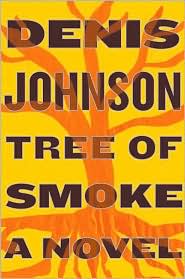
I’m harping on about language here because a) it’s what humans use to construct novels (even ones with text-art sharks) and b) I was similarly disappointed when I read Denis Johnson’s Tree of Smoke which was vaunted as having "prose of amazing power and stylishness " (Philip Roth). For a detailed look at the language in ToS, read B.R. Myer’s review here.

But all this criticism is actually leading to a more personal point. The one thing I will take away from The Raw Shark Texts is the knowledge that even in a frustrating, over-written, over-thought and under-executed (oh God, look how many hyphens I use!), there is room for truth.

It isn’t just the past we remember, it’s the future too. Fifty per cent of memory is devoted not to what has already happened, but to what will happen next. Appointments, anniversaries, all the rolling engagements and plans, all the hopes and dreams and ambitions which make up any human life – we remember what we did and also what we will do. (p 262)

Perhaps this excerpt appealed to me because I had recently blogged about time, memory and travel (here and here), and this felt like an extension of those thoughts. I would dispute the claim that fifty percent of memory is forward looking (it’s probably more like 0.5%), but let’s set that aside. I think I would still have folded the corner of page 262 regardless of what I had been thinking about lately. The reason: this passage contains a sort of truth sadly lacking elsewhere in The Raw Shark Texts. These words present an idea which feels intrinsically true, but is expressed in a fresh way. Sure, Hall may be crimping from a French Philosopher or a documentary on Alzheimer’s, but as it sits on page 262, this idea is fresh. It is unobtrusive stylistically but obtrusive theoretically. It calls into question one’s own conception of memory and links back (and forward) to all the other theorising about memory in the novel. And it does so without compound words and unspace and purely conceptual fish.

I guess, then, that this unobtrusive-stylistically-but-obtrusive-theoretically stuff is what I wanted to stem from the amnesia premise. But good on Steven Hall for writing the book his way, and I’m happy for all the people who found this Raw Shark Texts enjoyable – the world would be a terrible place if fiction only catered to my tastes.